What Goes Into a 250 Square Foot Backyard Putting Green
The turf is the last layer down, and everything beneath it decides how the green plays and drains for years.
October 13, 2026 · 4 min read
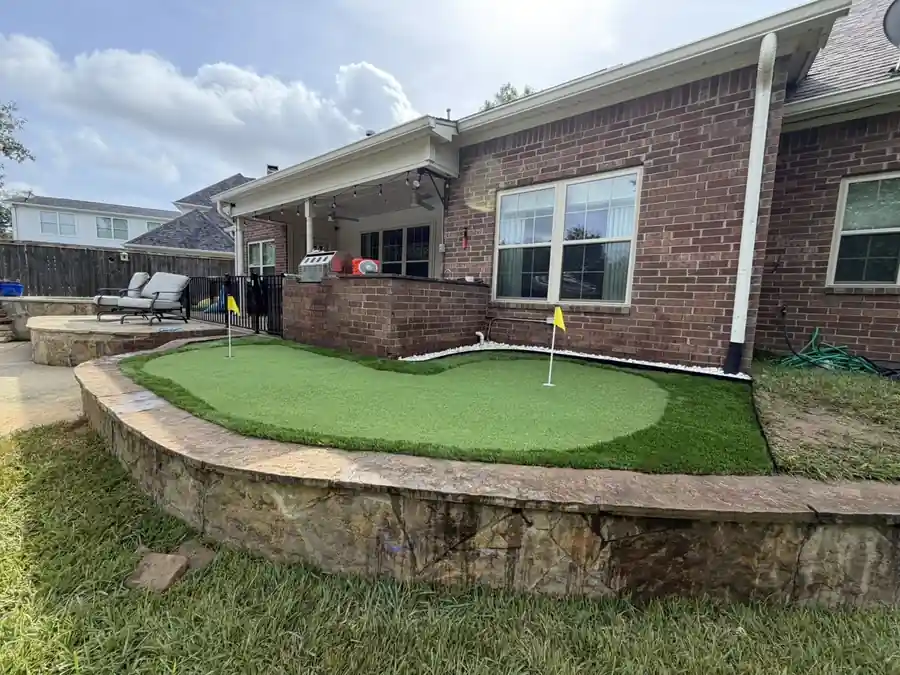
A backyard putting green looks simple from the patio: a patch of very short grass, a couple of holes, a flag. Nearly all the work is out of sight. The turf you see is the last thing to go down, and how the green plays and drains years later is decided by what's under it. Riaz Landscaping built a professionally crafted 250 square foot putting green at Brynmar Court in Tyler, designed with 2 cups, a slight left to right break and a nice outline of rough. Here's what goes into a green like that.
What 250 square feet really is
It's small enough to fit in a corner of a normal lot and big enough to be worth building. As a rough picture, 250 square feet could be a strip about 10 feet wide and 25 feet long, though real greens are rarely rectangles. Curves and tapered ends are common because they look natural next to a patio or a wall and give you putts from different angles. With two cups in a space that size you can play short, medium and long putts, and you'll want to, because the same cup from the same spot gets old in a week.
Excavation and base come first
The first step is removing sod and soil to make room for the layers that follow. Typically that means a compacted base of crushed stone, often a few inches deep depending on the site, topped with a thinner layer of finer material that's screeded smooth. Compaction is what keeps the surface from settling into dips, and a dip in a putting surface is a hole where there shouldn't be one. The perimeter gets a border, such as stone or steel edging, to hold the whole sandwich in place and give the turf something to anchor to. Ask any installer how deep the base goes and how it's compacted. If the answer is vague, the green will be too.
Drainage in East Texas clay
Red clay holds water. If rain pools on the base, the turf stays wet, the infill gets heavy and the surface can shift. A well-built green sheds water through a permeable base and slopes gently toward a spot where it can leave the area, whether that's a lawn edge, a drain or a rock bed. Where the site is low or flat, the installer needs a plan for water before there's a plan for turf. Conditions vary a lot from yard to yard, so this is something to look at on site, not decide from a brochure.
Building the break
A putting green's character comes from its contours, and the contours are built into the base, not the turf. The slight left to right break at Brynmar Court means the surface tilts gently across the line of a putt, so a ball aimed straight drifts to the right as it slows. The word slight matters. A small slope reads as a big one when the ball is rolling slowly, and a green with too much contour turns into a frustrating tilt instead of a fun challenge. Good builders check their slopes with a level and a string line, and they set the contours before any turf goes on, because changing them afterward means pulling the whole thing up.
Cups, collar and rough
Cups are cut into the base and fitted with sleeves so they hold their shape. Where they go is a design decision: far enough apart that putts don't cross each other, and on different parts of the contour so each one plays differently. Around the green, the outline of rough does two jobs. It gives the eye a clear boundary, the way a real course does, and it catches the occasional miss so a ball doesn't roll into the beds. Rough is usually a longer, shaggier turf, so the line between green and rough is easy to see.
Seams, infill and finishing
Artificial turf comes in rolls, so seams are inevitable. On a putting green they need to be cut cleanly, joined tightly and kept out of the main putting lines where possible. Fine sand is typically brushed in afterward to stand the fibers up and add a little weight so the surface rolls true. Then it's brushed again and checked with a ball, cup by cup, before anyone calls it done.
What to ask before you hire
- How deep is the base, and how is it compacted?
- Where will rain go once it hits the green?
- Who sets the contours, and how are they checked?
- Where will the seams fall relative to the cups?
- What does the edge look like where the green meets the lawn or the beds?
A green built with good answers to those questions behaves the same in year five as it did in week one. Carson and the Riaz Landscaping crew can talk through whether your yard has room for one and what shape would suit it. Call (903) 508-0646.
Riaz Landscaping + Home Services, LLC, (903) 508-0646
Call (903) 508-0646More articles
Steel, Mortared Chopstone or Natural Stone: Picking a Bed Edge in East Texas
The edge around a flowerbed does more work than it gets credit for, and the right one depends on your soil, your slope and your mower.
Why You Want a Stamped Design and a 2D Site Plan Before Anyone Digs
The cheapest place to move a patio is on paper, and a scaled plan is how you find out what needs moving.