Steel, Mortared Chopstone or Natural Stone: Picking a Bed Edge in East Texas
The edge around a flowerbed does more work than it gets credit for, and the right one depends on your soil, your slope and your mower.
October 13, 2026 · 4 min read
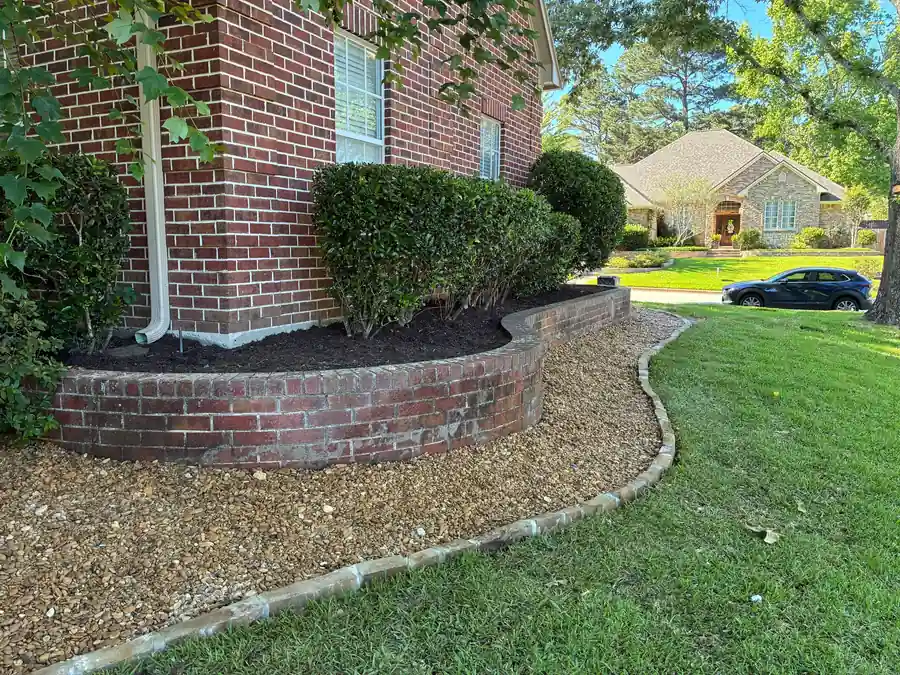
A bed edge does one job people forget about until it fails: it keeps two surfaces from slowly trading places. Mulch creeps into the lawn, St. Augustine runners creep into the bed, and within a couple of seasons a clean curve turns ragged. In East Texas the edge has a second job too. Our clay soils swell when they're wet and shrink when they're dry, so whatever you set along a bed has to live with ground that moves. Here's how three edges that Riaz Landscaping installs around Tyler behave, and where each one earns its place.
Steel border: thin, quiet and flexible
Steel edging is a flat strip driven into the soil so that only a thin lip shows above grade. Because it's slim, it bends into a tight curve without fuss and almost vanishes visually. What you see is the crisp line between mulch or rock and turf, not the edging itself. At The Woods in Tyler, Carson Riaz's crew built a 10x10 flagstone patio surrounded by steel border. That's a smart pairing. Flagstone already has plenty of texture and color, so a border that stays out of the way lets the stone do the talking.
Steel's limit is that it's a line, not a wall. It keeps mulch and rock from drifting and it's gentle on mower wheels, but it doesn't add height or weight, and it needs to be driven deep and joined properly so wet-season clay movement doesn't heave it out of true. When you're comparing quotes, ask how deep it goes and how the seams are joined.
Mortared chopstone: a built edge with weight
Chopstone is natural stone split into small, blocky pieces with rough faces. Set in mortar, those pieces become a low wall that reads as part of the landscape rather than something laid on top of it. The Hollytree project in Tyler used 200 ft of mortared latte chopstone border, along with 4 yards of 3/4 river rock, 4 pallets of St. Augustine sod and brown hardwood mulch. Two hundred feet is a long run. At that length the border isn't a detail, it's the outline of the whole property, and the mortar keeps every stone locked to its neighbors.
The tradeoff is rigidity. Mortar doesn't forgive a weak base, and on expansive clay a rigid edge needs a footing that's prepared for it, because a hairline crack can show up where the ground shifts under a poorly built run. That's a good reason to ask any installer what's under the stone, not just what's on top of it. In return you get an edge that holds mulch depth, resists wandering, and can handle a few inches of grade change.
Natural stone laid without mortar
Dry-laid natural stone, such as flat flagstone pieces or fieldstone, sits between the other two. Water drains through the joints, the edge tolerates small movement, and a stone that settles can be lifted and reset. Riaz Landscaping has also set natural stone borders beside new sod strips. The cost of that flexibility is the joints themselves. Grass and weed seed find gaps, so a dry-laid border wants a clean, compacted base and a little attention every season.
Matching the edge to the bed
- Tight curves and a clean, modern look usually point to steel.
- Long runs that define a front yard, or beds filled with river rock, often justify mortared stone, because loose rock migrates and heavy rock pushes against a thin edge.
- Beds beside freshly laid St. Augustine need an edge that keeps runners out of the mulch. Any of the three can do it if it's set at the right height.
- Where a bed meets a patio or walk, think about what the edge touches. Steel suits flagstone well, while stone against stone can look heavy.
- On a slope, a taller edge on the low side keeps mulch from washing out in a hard rain.
Height matters as much as material. An edge set flush with the lawn lets a mower ride along it and trim in one pass. An edge that stands a few inches proud holds more mulch or rock but means string trimming or hand work beside it. Decide which chore you'd rather have before the first stone goes in.
Dana Scarzone wrote in a Google review: "They installed a durable landscape border and beautiful river rock throughout our flower beds". That pairing of a firm edge with rock is the combination that keeps stones where they belong.
If you're standing in your yard trying to decide, call Carson at (903) 508-0646. He can look at the soil, the slope and the way the bed meets the lawn, then tell you which edge fits.
Riaz Landscaping + Home Services, LLC, (903) 508-0646
Call (903) 508-0646More articles
Why You Want a Stamped Design and a 2D Site Plan Before Anyone Digs
The cheapest place to move a patio is on paper, and a scaled plan is how you find out what needs moving.
What Goes Into a 250 Square Foot Backyard Putting Green
The turf is the last layer down, and everything beneath it decides how the green plays and drains for years.