What a Year of Flowerbed Maintenance Looks Like in Smith County
Good beds are the result of small visits on a schedule, not one big rescue in August.
October 13, 2026 · 3 min read
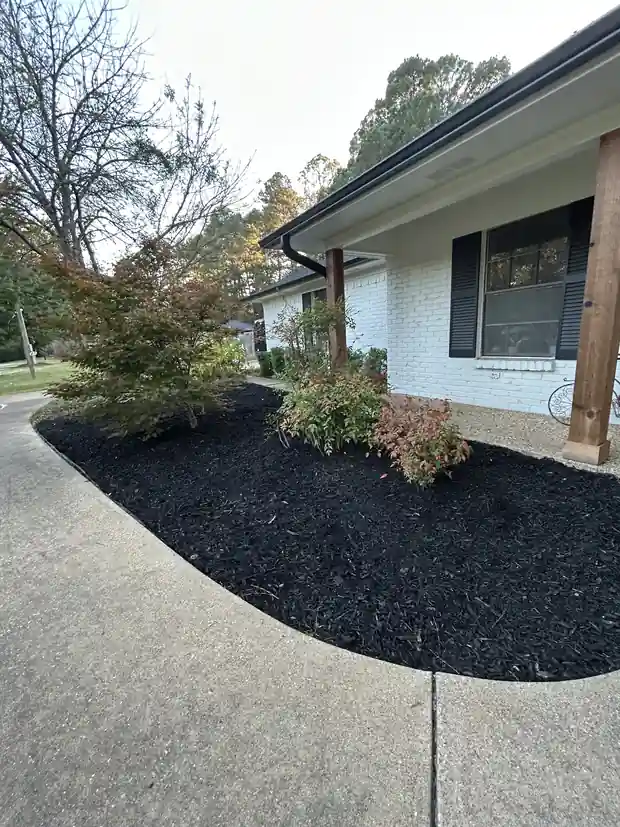
Flowerbeds don't look after themselves, and in Smith County they don't forgive neglect for long. Summer heat stresses plants, spring rain wakes up every weed in the county, and a hard freeze can surprise anyone. Riaz Landscaping runs maintenance plans for exactly this reason: Carson's team handles the not so fun stuff. Here's what a year looks like when those plans are working, and how to decide between river rock and hardwood mulch.
The shape of the year
Conditions vary from yard to yard, but the rhythm in East Texas is fairly steady. Winter is for cleanup and pruning dormant shrubs. Spring brings weed pressure, fresh color and the best planting weather. Summer is about keeping plants alive through heat, which means attention to watering and to what's actually suited to full sun. Fall is for cool-season color and getting beds ready for the next round. A maintenance plan takes those seasons off your plate.
Monthly: trimming, pruning and color
The core of the company's maintenance plans is monthly flowerbed care. That includes trimming, pruning and seasonal color touch-ups. Monthly visits matter because plants and weeds grow on their own schedule, not yours. A shrub that's shaped every month stays shaped. One that's ignored until fall needs a hard cut that leaves it ragged for a season. Pruning also depends on the plant. Some shrubs bloom on old wood and some on new, so cutting at the wrong time costs you flowers. Having a crew that knows each bed means that question is answered before the loppers come out. Seasonal color touch-ups keep the beds fresh as the weather turns, typically with cool-season color for fall and winter and heat-tolerant color for summer.
Once a year: the mulch refresh
The plans also include a consistent annual mulch refresh. Hardwood mulch breaks down. That's a feature, because it feeds the soil and holds moisture around roots, but it also means the layer thins over a year. A common practice is to top it up to about 2 to 3 inches rather than piling on more, since a thick mound against stems and trunks holds moisture where it can cause rot. Doing it once a year, on a schedule, keeps the beds looking fresh and keeps weeds from getting a foothold.
Quarterly: the outside of the house
Beyond the beds, the company also offers quarterly services, including professional exterior and interior window cleaning, and roof and gutter cleaning. In East Texas that last one isn't trivial. Pine needles, oak leaves and pollen collect in gutters, and a clogged gutter spills water right onto the beds you've just mulched, or down along the foundation. Cleaning them four times a year is a sensible habit for the landscaping below.
River rock or hardwood mulch?
Both have a place, and the Hollytree project in Tyler used both: 4 yards of 3/4 river rock and brown hardwood mulch. Here's how they differ.
- Hardwood mulch feeds the soil as it breaks down, keeps roots cooler and gives plantings a soft, uniform look. It needs that annual refresh, and it can wash or blow around in a heavy storm.
- River rock doesn't decompose, so it stays put and needs no yearly top-up. It's a good choice along foundations, under downspouts and on slopes where mulch would wash away. It holds heat in direct sun, though, and leaves and pollen settle between stones, so those beds still need an occasional tidy.
- Rock is harder to change later. If you replant often, mulch is easier to work around.
Neither is better everywhere. A bed of perennials and roses usually does well with mulch, while a strip at the base of a wall or beneath a downspout often suits rock. Plenty of properties end up with both, each placed where it works hardest.
Someone who checks in
Maintenance is a relationship as much as a task list. Jamey Whitley, who reviewed the company on Google, wrote: "He always checks in with us quarterly to make sure everything is going well." A check-in like that is the kind of habit that catches a failing plant or a drainage problem before it becomes a project. When you're comparing maintenance providers, ask what the check-in looks like, who comes out, and how you'll hear about problems.
To talk about a maintenance plan for beds in Tyler, Bullard, Lindale, Whitehouse or the surrounding area, call Riaz Landscaping at (903) 508-0646.
Riaz Landscaping + Home Services, LLC, (903) 508-0646
Call (903) 508-0646More articles
Steel, Mortared Chopstone or Natural Stone: Picking a Bed Edge in East Texas
The edge around a flowerbed does more work than it gets credit for, and the right one depends on your soil, your slope and your mower.
Why You Want a Stamped Design and a 2D Site Plan Before Anyone Digs
The cheapest place to move a patio is on paper, and a scaled plan is how you find out what needs moving.